
Most AI sessions for executives start with a powerpoint. In this one, there was only one Powerpoint slide in the entire session.
Michael started with a question: what are you most afraid of when it comes to AI?
It turned out to be the right place to begin. The answers came quickly, and they were candid. Within a quarter of an hour the room had named seven distinct concerns, and once they were on the whiteboard, something shifted. People stopped being polite about AI and started being curious about it. And then he dived into the tools!
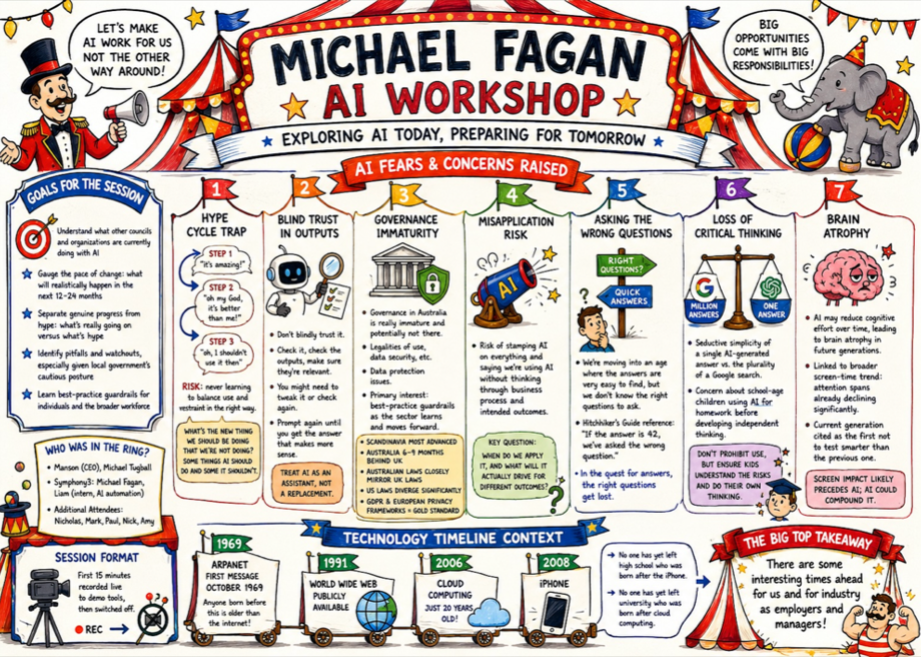
Four goals for the afternoon
Michael set out what the session was for before anyone opened a laptop. The aim was to understand what other councils and organisations are actually doing with AI right now; to gauge the pace of change and what will realistically happen in the next 12 to 24 months; to separate real progress from hype; to identify the pitfalls and watch-outs, especially given local government's understandably cautious posture; and to leave with best-practice guardrails, both for individuals and for the broader workforce.
This was not a session about whether councils should use AI. Staff already are. It was about how leaders get ahead of it.
The seven fears in the room
1. The hype cycle trap
Michael described the pattern he sees over and over. Step one: "It's amazing!" Step two: "Oh my God, it's better than me." Step three: "Oh, I shouldn't use it then." The risk is that people bounce between over-excitement and rejection and never learn to balance use and restraint. The more useful questions are: what is the new thing we should be doing that we're not? And what are the things AI should do, and the things it shouldn't?
2. Blind trust in outputs
Nobody in the room thought AI outputs should be trusted blindly, but several admitted their teams sometimes do. Michael's guidance was practical: check the outputs, make sure they are relevant, tweak them, prompt again until you get an answer that makes more sense. Treat AI as an assistant, not a replacement.
3. Governance immaturity
This was the concern that resonated most with a public-sector audience. AI governance in Australia is still immature and in some areas simply not there yet: legalities of use, data security, data protection. Michael gave the room a useful global benchmark. Scandinavia is the most advanced. Australia sits roughly six to nine months behind the UK, and our laws closely mirror theirs. US law diverges significantly. GDPR and the European privacy frameworks remain the gold standard. For councils, the primary interest is best-practice guardrails as the sector learns and moves forward.
4. Misapplication risk
There is a real risk of stamping "AI" on everything and claiming to be using it without thinking through the business process or the intended outcome. The key question Michael put to the room: when do we apply it, and what will it actually drive for different outcomes?
5. Asking the wrong questions
We are moving into an age where answers are easy to find but the right questions are not. Attendee Julie referenced The Hitchhiker's Guide to the Galaxy saying: “if the answer is 42, we've asked the wrong question.” In the quest for answers, the right questions get lost. For leaders, the skill that matters is framing the problem well before the machine gets anywhere near it.
6. Loss of critical thinking
A single, seductively simple AI-generated answer versus the plurality of a Google search: which one teaches you more? Several attendees raised concerns about school-age children using AI for homework before they have developed independent thinking. The consensus was not to prohibit use, but to ensure young people understand the risks and do their own thinking.
7. Brain atrophy
The most pointed concern in the room. AI may reduce cognitive effort over time, and some worried about what that does to the next generation. Michael placed it in a broader context: attention spans are already declining with screen time, and the current generation is the first cited as not testing smarter than the one before. The screen impact likely precedes AI, but AI could compound it.
A little perspective on pace
To ground the "how fast is this moving?" question, Michael walked through a timeline that surprised a few people. ARPANET sent its first message in October 1969, so anyone born before then is older than the internet. The World Wide Web became publicly available in 1991. Cloud computing is just twenty years old. The iPhone arrived in 2008.
Two observations followed. Nobody has yet left high school who was born after the iPhone. Nobody has yet left university who was born after cloud computing. The workforce shaped by these technologies from birth is only just arriving, and AI is arriving with them.
Then the laptops opened
The first fifteen minutes were recorded so attendees could revisit the tools demonstrated. After that the cameras went off and the room went hands-on, working through modules from Symphony3's own training platform: the tools Michael and the Symphony3 team actually use day to day.
Attendees:
- tried AI transcription and meeting tools like Granola and Wispr Flow;
- learned what Markdown files are and why they are useful for working with AI
- asked Copilot in Excel to build formulas and pull information from specific sheets and cells; and
- used Copilot in Word, PowerPoint and Outlook to draft, edit and summarise content.
Because people were logged in and testing the tools themselves, the conversation kept turning sideways in the best way. Attendees shared how they were already using AI in their own councils and picked up ideas from each other as much as from Michael.
A bonus for your prompting: switches
One of the most practical things to come out of Michael's work is a technique he calls prompt switches. A switch is a short command you define once in a conversation, such as /ATTACK, /HOLES or /NEXT, and then reuse whenever you want the AI to adopt a particular lens. /ATTACK asks it to raise the strongest evidence-based objections before answering. /HOLES lists missing information, hidden assumptions and unanswered questions. /NEXT recommends the single highest-leverage next action and explains why.
They are stackable, too. Paste a draft proposal into Copilot and add /HOLES /FAILHOW /NEXT, and you get the blind spots, the most likely failure mode and the best next step, in that order, without re-explaining yourself each time. For executives who want AI to push back rather than flatter, switches are a simple habit worth building. Michael has compiled a library of one hundred of them for senior leaders. Contact us and we are happy to share it.
What people took away
- Practical skills, not theory. Attendees left having transcribed a meeting, explored Markdown, built formulas and drafted documents with Copilot, all things they can apply back at their own council this week.
- Less fear through direct experience. Naming the concerns first, then testing the tools, gave people a grounded view of what AI actually does versus what they feared it might do.
- Proof it is already happening in local government. Hearing other CEOs talk about how they already use AI made clear this is not a future conversation. It is happening now, in councils like theirs.
- Big opportunities come with big responsibilities. The governance conversation did not dampen enthusiasm; it sharpened it. Guardrails are what make confident adoption possible.
A big top takeaway
Michael's closing line summed up the mood of the room: there are some interesting times ahead for us, and for industry, as employers and managers. Or, as he put it at the very start: let's make AI work for us, not the other way around.
Symphony3 runs this workshop as a full-day program for council leadership teams, covering the same tools, governance guardrails and hands-on modules in depth.
Michael’s full-day session shows you how to build a custom GPT or a custom co-pilot or your own agent, tailored and individualised for you.
Interested in an AI Workshop for your Executive Team?
Get in touch today!