Author: Michael Fagan
Part 1 of a 4-part series on Graduate Recruitment, AI and University Engagement
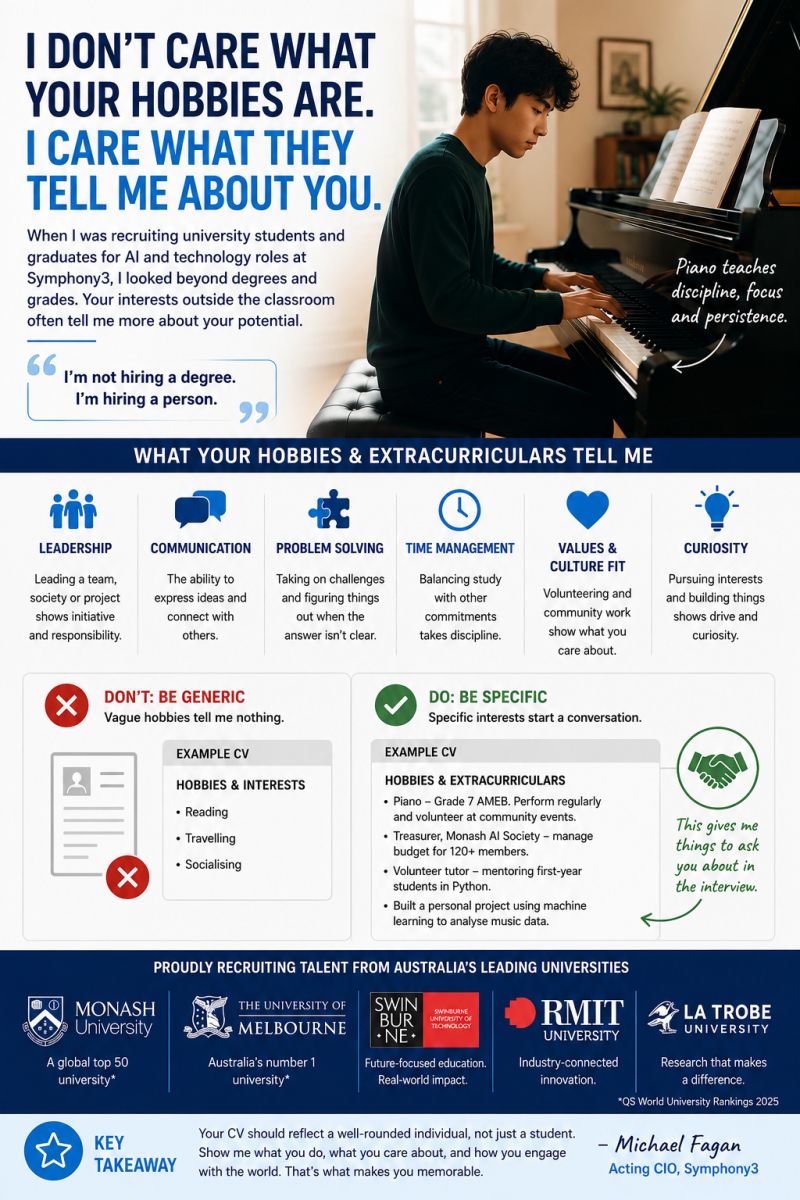
🎓 I don't care what your hobbies are.
Actually, that's not quite true.
I care very much about what you do when nobody is paying you to do it.
I recently helped recruit university students and graduates for AI and technology roles at Symphony3Symphony3. And one thing I noticed repeatedly:
Too many CVs looked almost identical.
📜 Degree.
💾 Subjects.
🤖 Technical skills.
🛒 Maybe a part-time job.
🖥️ Then a long list of software tools.
Out of the dozens of CVs that I reviewed, exactly one, and only ONE, listed any hobbies.
The problem is that a CV like that maybe tells me what you have been taught. It doesn't tell me who you are. Or how you behave. Or what you do when you are genuinely interested in something.
I have never hired a degree. I always hire a person.
I have taught more than 200 people over the past 20 years how to conduct interviews. For all roles, I insist that my recruiters ask themselves this question at the end of the interview before doing anything else: "Would you be happy sitting next to this person for the next 3 years, and have them work in your team?" If the answer is No, then don't hire them.
We are human beings, and we want to work alongside other humans, not robots.
That is why students should include hobbies, societies, volunteering, side projects and extracurricular activities on their CV.
Not as decoration. As evidence.
💡 If you captain a sports team, or If you run a university society, that tells me something.
If you built an application because you were frustrated by a problem, or Volunteer every weekend, that tells me something.
If you spend your spare time learning AI, building things or contributing to open source, that tells me something.
Early in your career, your interests outside university may tell me more about your potential than another line of academic achievement.
The best candidates are not always the ones with the most impressive CVs.
They are the ones who have done interesting things.
So don't write:
> “I enjoy reading, travelling and socialising.”
Tell me something real.
- What you built.
- What you organised.
- What you learned.
- What you failed at.
- What you care enough about to do without being asked.
So how did we go with our recruitment? I hired 6 people across three different businesses. Exactly half of them progressed to a next-round interview because of an interesting hobby I teased out of them. One of them played Piano - Chopin to be exact. I am tone deaf, but my co-interviewer Eamon DooleyEamon Dooley is an opera singer and informed me that Chopin showed dedication, hard work and focus - let's progress this guy.
Your CV is not just a record of your education. It is your first attempt to answer a much more important question:
“Why should I want to meet you?”