Author: Michael Fagan

Part 2 of a 4-part series on Graduate Recruitment, AI and University Engagement
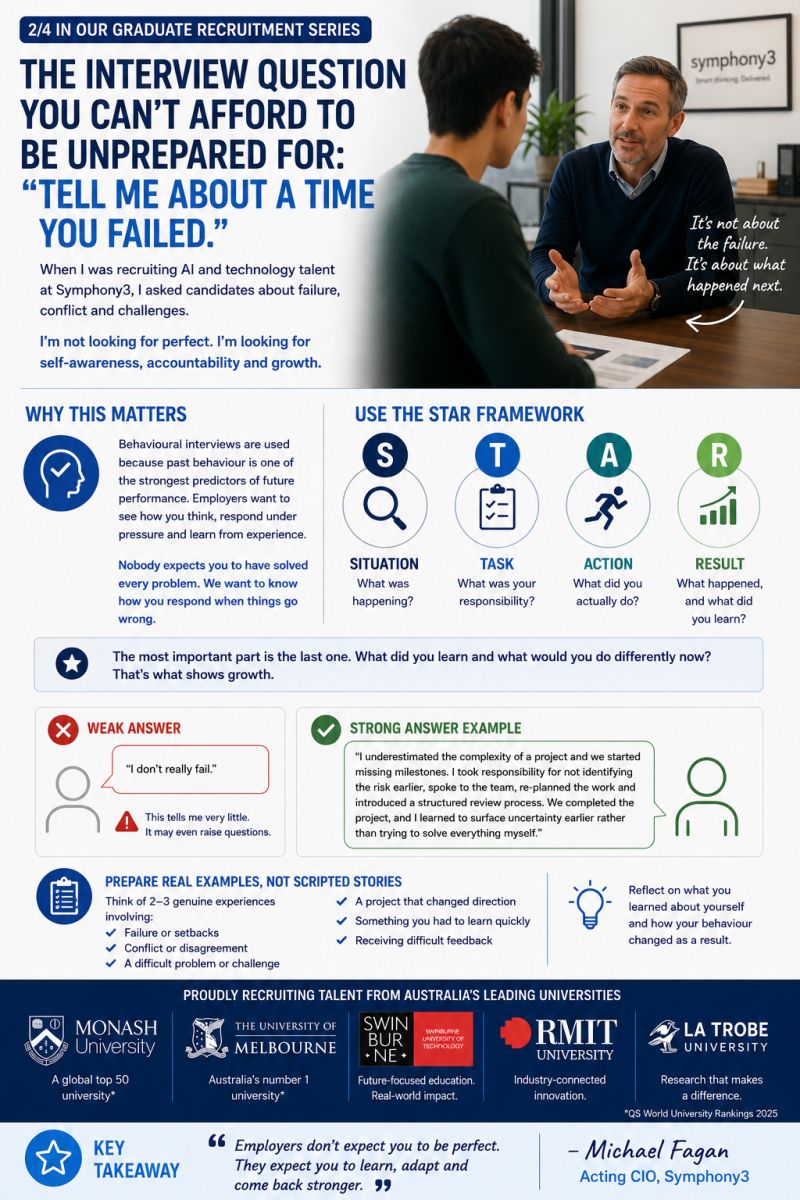
🎓 “Tell me about a time you failed.”
This is where a lot of interviews become uncomfortable. Which is kind of the point. Life is messy, work is ambiguous, we don’t know all the answers – so new hires into the workforce need to get used to being uncomfortable.
Having lived and worked in South Asia for the best part of 25 years, it is a particularly difficult question for candidates from that region. Rooted in cultural norms or society's expectations, it is stifling.
When I was recruiting AI and technology talent for Symphony3 and Star Group, I asked candidates about failure.
Conflict.
Things going wrong.
Difficult feedback.
Projects that did not work.
Some candidates clearly thought there was a correct answer. There isn't. But there most certainly is a wrong answer: “I’ve never failed”
I am not looking for the person who has never failed. That person either hasn't done very much or isn't being entirely honest and it seriously derails trust in the interview. ‘It’s only those who do nothing that make no mistakes.’ (Joseph Conrad, 1896)
What I am interested in, is what happened next after failure.
- Did you take responsibility?
- Did you understand your part in the problem?
- Did you blame somebody else?
- Did you learn anything?
- Did your behaviour change afterwards?
A candidate who says:
“I don't really have any major failures.”
doesn't give me much to work with.
A candidate who says:
“I made a poor assumption, it caused a problem, I initially tried to solve it myself and that made things worse. I eventually recognised I needed help, changed the approach and learned to surface uncertainty earlier.”
Now we have something to discuss. That answer tells me far more.
I use the STAR framework as a simple way to prepare:
- Situation - What was happening?
- Task - What was your responsibility?
- Action - What did you actually do?
- Result - What happened, and what did you learn?
But please don't memorise a series of polished stories. That is usually obvious. Instead, think about three real experiences:
- Something that went wrong
- A disagreement or conflict
- A difficult problem you had to solve
Then ask yourself:
What did I learn about myself?
That is often the real answer.
The working world is full of ambiguity.
Plans change.
Technology fails.
Customers disagree.
Teams have conflict.
Projects go over time and over budget.
I don't expect a graduate to have solved all of that before joining us. I do want to know whether they can reflect, adapt and improve. So prepare for the failure question. Not because we expect you to be perfect. But because we don't.
Coming up in Part 3: why you should stop telling interviewers what you can do and start showing them.