Author: Michael Fagan

Part 3 of a 4-part series on Graduate Recruitment, AI and University Engagement
"Your CV gets you in the door, your Portfolio gets you the senior conversation, your thinking gets you the job"
Storytime: When Guy Russo took over Kmart Australia Limited he changed quite a lot of things (understatement I know). One of the things he did that most people don't know about because it wasn't customer facing was encourage our buyers to be proud of the products they brought to market, and to talk to the media about it. He brought Seven Network and Nine on buying trips and invited them into our sourcing offices, showing them behind the wizard's curtain. Our buyers were terrified of "live TV" of course, but Guy's advice to them never left me: "you sell more forks than anyone in Australia, and you sell more plush toys. When you get in front of the camera, hold that fork or that toy, and talk about what you do, because to most other people it's magic..."
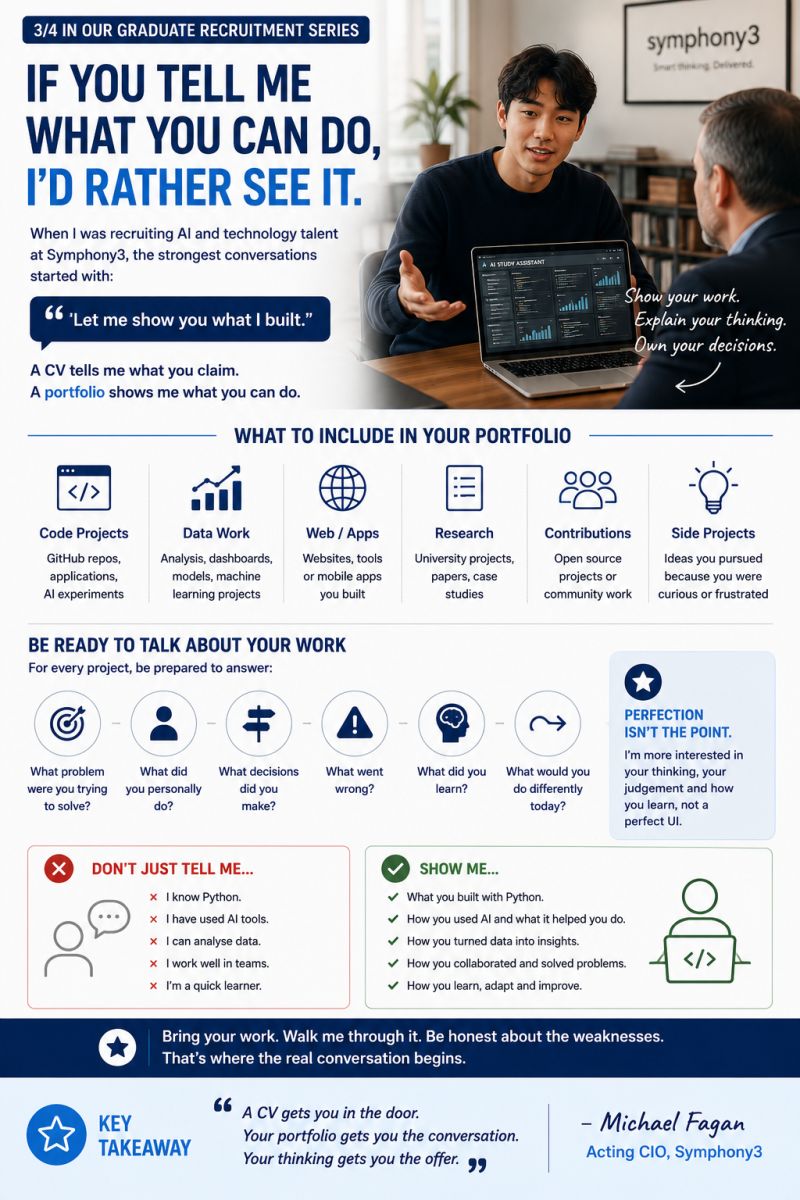
If you tell me you can code, analyse data or build with AI, I will probably believe you. But I would much rather see it. When we were recruiting AI and technology talent at Symphony3 and Star Group, the strongest interview conversations included a pivot with "Let me show you what I've built...."
Instead of me asking “Do you know Python?”, we could talk about what the candidate actually built with it. Instead of asking “Have you used AI?” we can discuss **how** you used it.
What worked.
What failed.
What you would change if I gave you scenario X.
A CV tells me what you claim to be able to do, a portfolio gives me something to investigate and interrogate. It might be any one of :
- A GitHub repository
- A personal website
- A university project
- An AI experiment
- A data analysis
- An application you built
- A research project
- An open-source contribution
- A side project
It doesn't need to be perfect. In fact, I am often more interested in a project with visible limitations than a beautifully polished project where the candidate cannot explain how it works. This is the crux of both technical and AI-related conversations by the way - for every project, you should be able to answer:
- What problem were you trying to solve?
- What did you personally do?
- What decisions did you make?
- What went wrong?
- What did you learn?
- What would you do differently today?
Those questions tell me how you think, and that is more important than whether your project has a perfect user interface.
My advice to students is simple:
Bring your work and show it. Don't make the interviewer imagine what you can do. Show them. Open the project - Walk through it - Explain your decisions - Be honest about the weaknesses - and most of all.... Own the work.
The candidates who did this were often much more comfortable in the interview. They weren't trying to convince us they could do something.
They were talking about something they had actually done. Much like Callum Smith did the first time he appeared on TV 😉